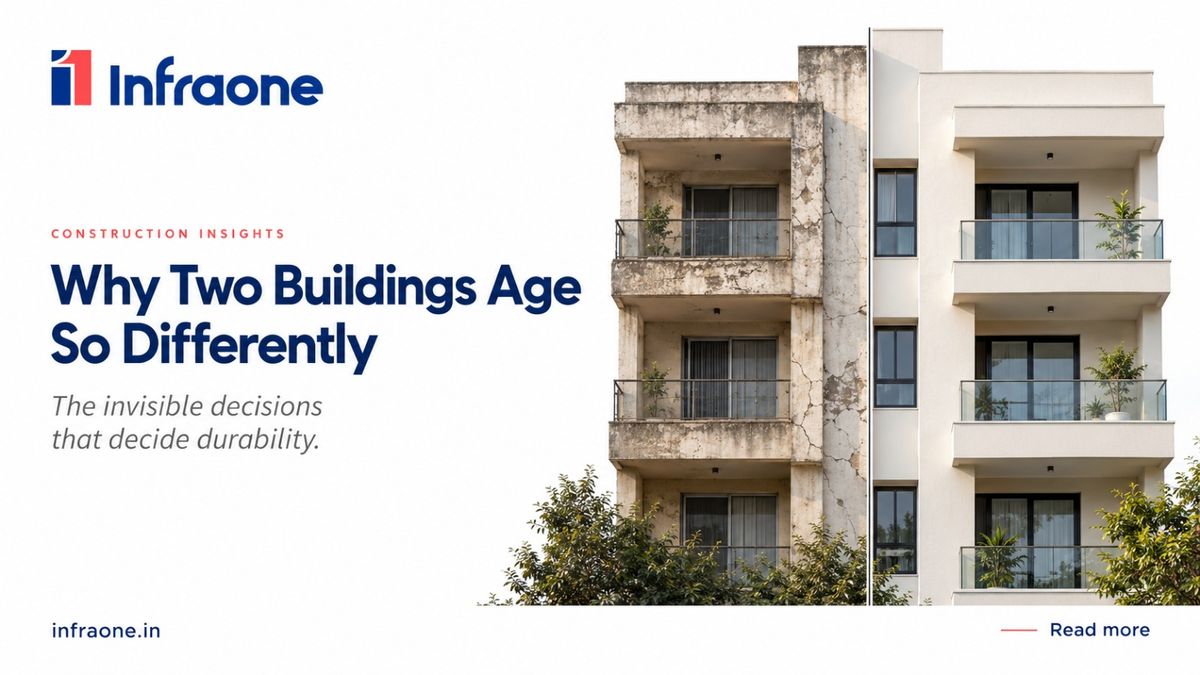
Why Two Buildings on the Same Street Age So Differently
Two buildings constructed at the same time can look decades apart within a few years. The reason is rarely the design. It is the invisible decisions made during construction.
The Mystery on Every Old Street
Walk down any older residential street in an Indian city and you will notice something strange. Two buildings, constructed around the same time, standing side by side, look decades apart in age. One has clean walls, tight windows, and no visible cracks. The other has damp patches, flaking paint, and cracks crawling from every corner.
They faced the same weather. The same monsoons. The same summers. So why did one age gracefully and the other fall apart?
The answer is almost never the design. It is almost always the invisible decisions made during construction, the ones nobody sees once the building is painted and occupied.
The Concrete Nobody Inspected
Two sites can use the same brand of cement and still end up with concrete of very different strength. The difference lies in the water added during mixing.
A mason who adds extra water to make the mix easier to pour is quietly reducing the concrete strength by twenty to thirty percent. The building looks identical on handover day. Ten years later, one is holding firm and the other is showing stress.
The Curing Everyone Skipped
Concrete gains most of its strength in the first two weeks, but only if it is kept wet during that period.
A site that cures its slabs for the full duration produces concrete that keeps getting stronger for years. A site that stops curing after two days locks in a permanent weakness that no repair can fully undo.
The Steel Cover Nobody Measured
The distance between the reinforcement bars and the outer surface of the concrete determines whether moisture can reach the steel.
Too little cover, and the steel begins to rust within a few monsoons. Rusting steel expands, cracks the concrete around it, and the damage accelerates from there. This single detail, invisible once the concrete is poured, decides whether a building lasts thirty years or sixty.
Why Doing It Right Costs So Little
None of these decisions cost much money. Curing requires water and discipline. Correct water-cement ratio requires a mason who follows the mix design instead of his instinct. Proper steel cover requires cover blocks that cost a few rupees each.
The expensive part is not doing them right. The expensive part is doing them wrong and paying for it later.
The Uncomfortable Truth
The decisions that determine how a building ages are made by people the owner rarely meets, at moments the owner rarely witnesses, using materials the owner rarely inspects. By the time the consequences appear, everyone involved has moved on.
The buildings that age well are not lucky. They are the product of a hundred small decisions made correctly, often by people who cared even when nobody was watching.