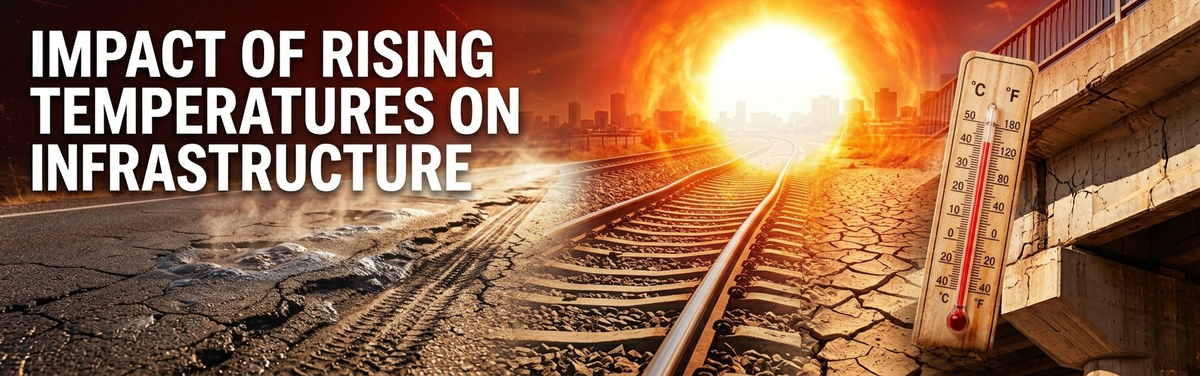
India Is Burning — and So Is Its Economy
When the mercury climbs past 40°C across vast stretches of India — from the Gangetic plains to the Deccan plateau — it doesn't just make life uncomfortable. It begins to silently dismantle the very systems that keep a 1.4 billion-person economy moving: roads buckle, power grids fail, and millions of workers simply cannot step outside.
India is warming at roughly 0.15°C per decade, faster than the global average in many of its densely populated interior regions. Scientists warn this is not an anomaly — it is the new baseline, and it is accelerating. What was once a two-month summer ordeal is becoming a five-month siege, and the consequences for hard infrastructure and human productivity are severe, measurable, and growing.
"Heat is the silent multiplier — it doesn't destroy economies in a single event, it erodes them daily, worker by worker, brick by brick."
— Climate Resilience Research Forum, 2024The infrastructure under stress
India's built environment was largely designed for the climate of the mid-20th century. Roads, bridges, power transmission lines, rail tracks, and concrete structures were engineered with thermal tolerances that are increasingly being exceeded. The physical consequences are now routine news.
Roads & highways
Bitumen softens and bleeds at sustained temperatures above 45°C, causing rutting, potholes, and surface deformation — especially on national highways carrying heavy freight loads.
Power grids
Transformer failures spike in peak summer as electricity demand for cooling surges. Overhead transmission lines sag, increasing fault risk. Load-shedding cascades follow, affecting industry and hospitals.
Urban buildings
Concrete spalling, facade cracking, and accelerated material fatigue reduce the structural lifespan of urban housing stock — particularly in affordable housing built with budget materials.
The economic cost of infrastructure repair and premature replacement runs into tens of thousands of crores annually. But the deeper cost is less visible: delayed projects, slower logistics, increased maintenance overheads, and a growing gap between planned infrastructure lifespans and real-world performance.
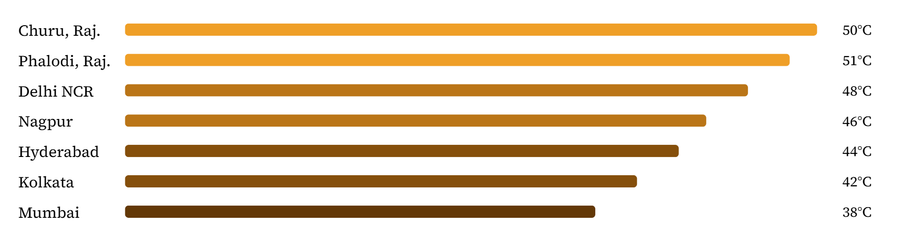
Peak summer temperatures across India
The vanishing workforce
Infrastructure damage is visible and countable. The erosion of human productivity is harder to see — but it may be the larger threat. India's workforce is one of the world's most heat-exposed. Over 600 million workers are employed in outdoor or non-air-conditioned settings: construction, agriculture, street vending, waste collection, brick kilns, salt pans, and transport.
Human physiology imposes hard limits. Above a Wet Bulb Globe Temperature (WBGT) of 26–28°C, physical work capacity begins to drop measurably. Above 32°C WBGT, working at full pace becomes medically dangerous. India's outdoor workers regularly face conditions that exceed these thresholds for months at a time.
The ILO estimates India loses approximately 101 billion labour hours per year to heat stress — the highest of any nation globally. This translates to roughly 4–4.5% of total working hours annually, with agriculture absorbing 60% of those losses and construction accounting for a further 19%.
Construction
India's ₹111 lakh crore infrastructure push relies on over 50 million construction workers. Mandatory mid-day work stoppages, heat strokes, and absenteeism are stretching project timelines by months.
Transport & logistics
Truck drivers face fatigue and heat exhaustion on long hauls without AC cabins. Last-mile delivery workers on two-wheelers face direct sun exposure, increasing accident risk and attrition rates.
Agriculture
Farmers and labourers shift to pre-dawn and evening work windows. Harvest efficiency drops. Crop damage from heat and erratic monsoons compounds labour losses, threatening rural livelihoods.
A compounding crisis: when both fail together
The truly dangerous dynamic is not infrastructure stress or labour stress in isolation — it is when both occur simultaneously, as they inevitably do. A major power outage during a 47°C heat wave doesn't just shut off fans and coolers for workers. It stops pumping stations, halts construction cranes, disrupts cold chains, and cascades through every system that depends on electricity.
Meanwhile, the very workers needed to repair the damaged infrastructure — linesmen, road repair crews, civil engineers on-site — are themselves operating under dangerous heat conditions, slowing the recovery response and creating a feedback loop of delay.
"The cities most vulnerable are not the richest or the poorest — they are the ones growing fastest, where new infrastructure is being built by workers with the least heat protection."
Urban Heat & Equity Report, CSE IndiaWhat can be done?
The challenge is immense but not unanswerable. Countries and cities that have faced similar pressures — from the Gulf to Singapore to parts of southern Europe — offer a range of adaptive strategies that India can adapt at scale.
Climate-resilient materials
Adopting high-performance bitumen, thermally treated concrete, and heat-resistant steel for public infrastructure can significantly extend operational lifespans under extreme temperatures.
Shifted work schedules
Legal mandates for pre-dawn and evening construction shifts during declared heat emergencies, with wage compensation, can protect workers without halting projects entirely.
Cool rest infrastructure
Employer-funded shaded rest zones, hydration stations, and emergency cooling centres at construction and agricultural worksites are low-cost, high-impact interventions.
Urban greening
Expanding tree cover, green roofs, and reflective road surfaces in cities can reduce the urban heat island effect by 2–4°C — meaningfully extending safe outdoor work windows.
India stands at a crossroads. Its demographic dividend — hundreds of millions of young, working-age people — is the very asset most vulnerable to rising heat. The window to build climate-resilient infrastructure and protect outdoor workers from the worst impacts is not indefinitely open. Every year of inaction embeds higher costs into the system: shorter infrastructure lifespans, more lost working hours, greater public health burdens, and a slower, harder path to the prosperity India is reaching for. The temperature is rising. The clock is running.