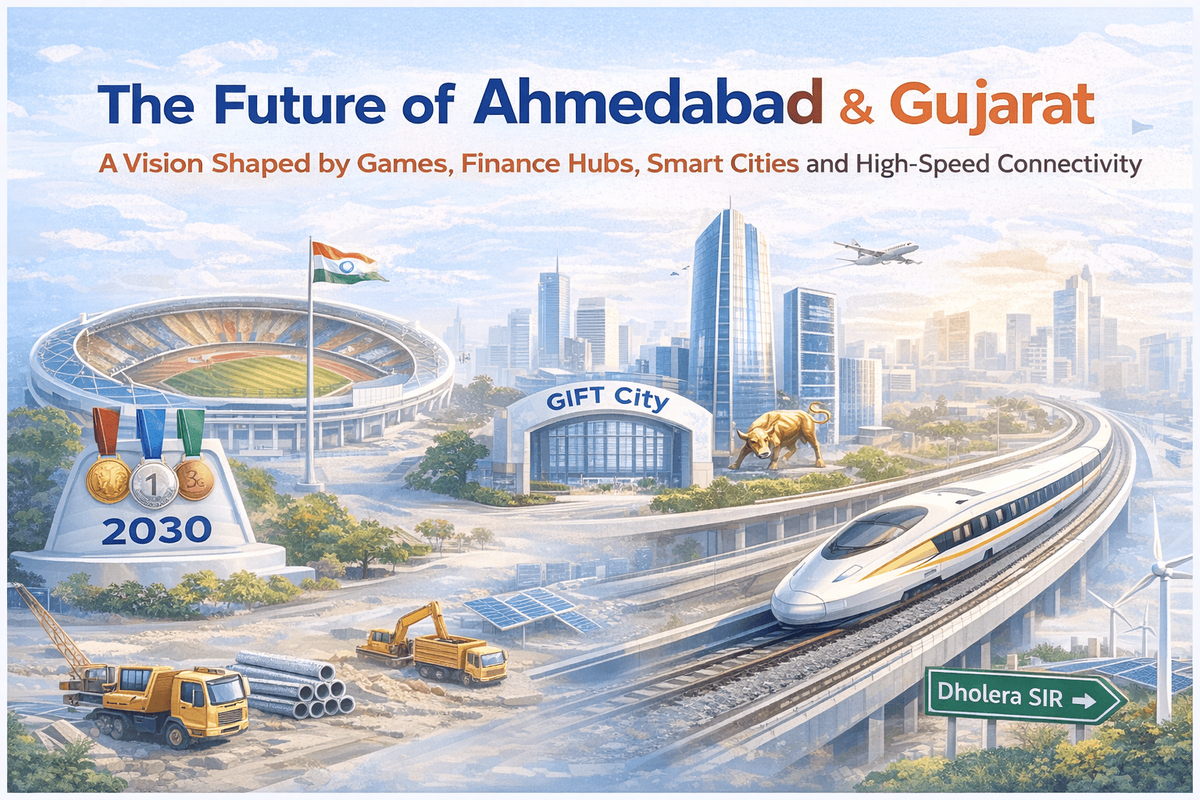
The Future of Ahmedabad & Gujarat A Vision Shaped by Games, Finance Hubs, Smart Cities and High-Speed Connectivity
1. Gujarat at an Inflection Point
Ahmedabad and Gujarat stand at an inflection point. Over the next decade the region is being reimagined not merely as an industrial and trading heartland, but as a global events venue, a financial services gateway, a high-technology manufacturing hub and a connected transport corridor. These are not isolated projects — they are mutually reinforcing initiatives that together change how people live, work, invest and build in the state. Hosting the 2030 Commonwealth Games has accelerated investment in sports, urban mobility and civic infrastructure for Ahmedabad, while larger projects such as GIFT City, Dholera Special Investment Region (SIR) and the Mumbai–Ahmedabad high-speed rail corridor are re-wiring the economic map of Gujarat.
2. 2030 Commonwealth Games: Catalyst for Urban Transformation
Hosting a major multisport event of the scale of the 2030 Commonwealth Games acts as a megaproject catalyst. Beyond stadiums and athlete villages, the Games focus state and city budgets on metro extensions, riverfront improvements, traffic management, hospitality capacity and last-mile urban services — investments that remain long after the medals are collected. Gujarat’s recent budgetary allocations show this explicitly: hundreds of crores have been earmarked to upgrade sports and city infrastructure, expand metro links and reinforce drinking-water and urban resilience projects to support the Games and the city’s post-Games legacy. These directed investments not only create construction demand in the short term but also raise the baseline for future private investment in housing, retail and services across Ahmedabad.
3. GIFT City: India’s Emerging Global Financial Hub
Parallel to the event-led urban upgrade is a deliberate push to position Gujarat as a national financial and services hub. GIFT City (Gujarat International Finance Tec-City) is already functioning as India’s flagship greenfield financial centre, with global finance, fintech and back-office operations clustering in its precincts. A mature GIFT ecosystem raises the game for talent, regulation and capital flows — it is the place global asset managers, banks and fintech firms look to when considering a South Asia foothold. The presence of an active international finance centre increases demand for premium commercial real estate, high-quality corporate services and international-standard digital infrastructure in the region, which in turn grows the local construction and professional services markets.
4. Dholera SIR: The Future Industrial Powerhouse
On the manufacturing and industrial front, the development of Dholera Special Investment Region (SIR) is the state’s strategic bet on large-scale, planned industrialisation. Dholera’s master plan — backed by road, power, water and airport logistics — aims to attract advanced manufacturing, semiconductor allied units, aerospace and data centres. Estimates place the total project investment in the billions of dollars, reflecting an ambition to create a new industrial axis that complements the traditional clusters in and around Ahmedabad and Sanand. As trunk infrastructure is delivered, expect decadal demand for construction materials, roads, utilities and factory shells — an enormous opportunity for suppliers, contractors and technology platforms that streamline procurement and project management.
5. Mumbai–Ahmedabad Bullet Train: High-Speed Economic Integration
Connectivity is the glue that binds these ambitions. The Mumbai–Ahmedabad high-speed rail corridor — India’s first bullet-train project — will dramatically compress travel time between India’s commercial capital and Gujarat’s growth corridor. Historical estimates placed total project costs in excess of ₹1 lakh crore, with cumulative expenditures already running into many tens of thousands of crores. Faster intercity travel improves the labour market catchment, enables business travel as a day-trip, and makes Ahmedabad and Gandhinagar more attractive as regional corporate bases for firms with pan-India operations. For construction planners, the bullet train creates both direct demand (stations, access roads, urban integration works) and indirect demand (new office campuses, hotels and housing near major transit nodes).
6. A Programmatic Shift in Gujarat’s Growth Model
When we connect the dots — event-led urban renewal, world-class finance, planned industrial growth and high-speed rail connectivity — the picture that emerges is of a region shifting from project-by-project development to programmatic, sustained economic growth. State budgets and project allocations are already running into thousands of crores for metro expansion, sports infrastructure, trunk utilities for Dholera and capacity building at GIFT, while single megaprojects like the bullet train carry multi-lakh-crore price tags. These numbers signal multi-year construction pipelines, predictable procurement schedules and a need for higher standards in materials, logistics, workforce training and digital project controls.
7. Opportunities for Businesses and Startups
For local businesses and startups, the opportunity is twofold. First, there is the direct pipeline of public-sector and private institutional projects stadiums, metros, bulk water and sewerage works, industrial sheds and fintech parks which require robust supply chains. Second, there is the structural shift toward higher-quality demand: international investors and large Indian corporates expect standardized procurement processes, transparent accounting, efficient logistics and faster execution cycles. Companies that can supply materials with digital invoicing, real-time delivery tracking and reliable credit terms will win a disproportionate share of this growth.
8. Infraone’s Role in the Transformation
For Infraone, this regional transformation is precisely the market we were designed for. A technology first procurement and supplier platform can reduce friction across large, recurring public and private construction programs. By enabling transparent invoicing, project-wise ledgers and data-driven demand forecasting, Infraone can help suppliers scale to meet multi-crore projects while helping contractors reduce time-to-delivery and manage working capital more efficiently. As Ahmedabad and Gujarat move toward a future defined by global events, finance, smart manufacturing and high-speed mobility, the construction ecosystem will reward platforms and partners that bring clarity, speed and scale to the supply chain.
9. The Next Decade: Build for Scale
The next ten years will redefine Gujarat’s urban and industrial landscape. For builders, investors and service providers the message is clear: prepare for larger, better-funded and faster projects and build the systems today that will allow you to participate fully in this moment.